Passing drills in soccer help players improve accuracy, ball control, and decision-making on the field. They develop essential game skills such as first touch, timing, and awareness of teammates and opponents. Regular practice boosts confidence, tactical awareness, and quick decision-making on the field.
According to U.S. Youth Soccer, regular passing practice strengthens ball control, tactical awareness, and the ability to respond effectively in game situations.
In this guide, you’ll learn what passing drills are, why they are important, examples for beginners to advanced players, and how youth, girls, boys, and adults can practice effectively. You’ll also see how to progress in skill level and the equipment needed to get started.
Table of Contents
What are Soccer Passing Drills?
Soccer Passing Drills are exercises designed to help players develop the skill of moving the ball precisely to teammates while maintaining control. Passing involves sending the ball accurately, and a drill is a structured activity meant to improve consistency, technique, and confidence.
These drills focus on key elements such as short and long passes, one- and two-touch passes, and passing while moving or under pressure. Practicing these exercises regularly strengthens ball control, awareness of teammates and space, and quick decision-making during games.
U.S. Youth Soccer on fundamental ball skills states that repeated technical practice, including passing, equips players to handle match situations more effectively by improving accuracy, first touch, and tactical understanding.
That’s why soccer programs are built to guide players from core passing skills to advanced, game-ready execution.
Passing drills work for everyone, from beginners to advanced players who are under pressure. They are essential because accurate and timely passing is central to effective team play. Soccer passing training helps you pass the ball like a pro football player just like in the video below.
What are the Benefits of Soccer Passing Drills?
The benefits of passing drills go beyond simply kicking the ball between teammates. These drills strengthen skills, quick thinking, and teamwork for matches. The key benefits include better ball control, accuracy, speed of play, communication and awareness on the field.
-
Quicker Ball Release Under Pressure
Ball passing drills train you to control and pass the ball in fewer touches, so when a defender closes in, you can release the ball faster without panicking. -
Better First-Touch Setup
A perfect first touch puts the ball where you want it—inside, outside, or across your body—making the next pass much easier and faster. -
Disguised Passing
By practicing no-look and feint passes, also referred to as a deceptive movement, you learn to trick opponents to just create an opening rather than actually passing the ball to your teammate -
Mastering Passing Angles
Drills teach you how to adjust body shape and ball angle, so your passes cut between defenders (splitting lines) or bend around them. -
One-Two (Give-and-Go) Combinations
Practicing quick wall passes improves the ability to get past a defender with a simple 1-2 combination — one of the most effective tricks in attacking soccer. -
Switching Play Smoothly
Even solo drills with cones target long passing accuracy, training you to move the ball from one side of the field to the other, opening up space. -
Weak Foot Development
Many passing drills emphasize using both feet, helping you trust your weaker side. That instantly doubles your options in real game situations. -
Improved Decision Speed
By repeating passing under different constraints (one touch, two touches, moving cones), you force your brain to process faster, which transfers directly into quicker game decisions. -
Creating Space with Movement
Even in 1-on-1 or solo wall drills, you practice passing and then moving into space (e.g., wall pass then sprint diagonally). This habit builds attacking runs. -
Confidence in Tight Spaces
Small, short passing drills mimic being under pressure. Once you’re comfortable in these tight drills, you’ll feel calm when surrounded by opponents in real games.
Level Up Passing Skills Step by Step
Short passes, long balls, and combination play — each stage of development builds on the last. See how our pathway programs guide players through every level of passing.
What are the Techniques Used in Soccer Passing Drills That Will Make You a Pro?
The techniques used in soccer passing drills are categorized in four types: short pass, medium pass, long pass, and aerial or advanced long pass.
Short Pass (5–15 yards)
Techniques often trained in small-space drills:
- Inside-foot push pass – most common, accurate, controlled.
- Outside-foot pass – used to disguise intent or keep body position open.
- One-touch pass – returning the ball immediately without controlling.
- Wall pass (give-and-go) – pass and quickly move into space to receive it back.
- Back-heel pass – deceptive pass using the heel in tight spaces.
Medium Pass (15–30 yards)
Drills here focus on breaking lines and keeping speed of play:
- Firm ground pass (driven inside pass) – low, powerful, straight to feet.
- Through pass (slip ball) – into the gap behind defenders for a runner.
- Combination passes (third-man runs) – pass → layoff → forward movement.
- Curved inside-foot pass – bending pass around an opponent.
Long Pass (30–50 yards)
Used in switch-play and counter-attacks; drills emphasize accuracy + technique:
- Lofted pass (instep drive with laces) – high arc, over defenders.
- Diagonal switch pass – cross-field to switch play.
- Chip pass – short, lifted ball over an opponent’s leg/line.
- Crossing drills – delivering into the box (early cross, cutback, far-post cross).
- Outside-foot long pass (“Trivela”) – bending the ball with disguise.
Aerial / Advanced Long Pass (Specialty Drills)
Trained less frequently, but make players unpredictable:
- Volley pass – striking the ball out of the air.
- Half-volley pass – hitting just after the bounce.
- Header pass – redirecting ball with the head for teammates.
- Flicked pass – toe or outside-foot flick to change direction.
- Over-the-top lob – long, floated ball to beat a defensive line.
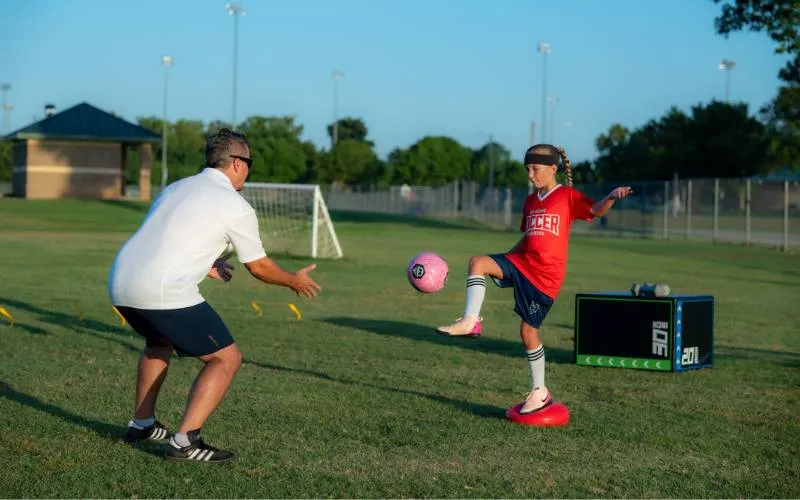
How Much Should You Practice Soccer Passing Drill Per Day?
The United Soccer Coaches recommends about 20–30 minutes of daily passing training, which includes patterns and functional training. This means short, targeted drills where players focus on first touch, accuracy, and speed of release. For example, practicing 100–150 passes with each foot in a session is more valuable than kicking the ball aimlessly for an hour.
Players should divide practice into focused sets: 5–7 minutes short passes, 5 minutes long passes, and 5–10 minutes combination passing. This structure develops precision while preventing fatigue.
How Much Should an Adult Practice Soccer Passing Drill Per Day?
For adults aiming to improve their soccer skills, dedicating at least 20 minutes daily to individual training is highly recommended. This focused practice can significantly enhance technical abilities such as ball control, passing, and shooting.
While daily practice is beneficial, it’s essential to balance training with adequate rest to prevent overtraining and potential injuries. Practicing individually 2–3 times a week promotes skill growth while allowing proper recovery. For recreational players, 2–3 weekly sessions of 30–45 minutes each can boost skills and fitness.
How Much Should Youth Practice Soccer Passing Drill Per Day?
Boys and girls can differ in strength, speed, and endurance, affecting the way drills are executed and their intensity. Understanding these differences allow coaches to adjust practice sessions to enhance passing skills effectively for both genders.
According to The Johns Hopkins University, anterior cruciate ligament (ACL) injury or tear is more common in girls than boys. Therefore, advanced long pass techniques for girls under 15 are included but with gradual intensity progression.
This shows that boys can usually train with longer, more intense drills that focus on power and distance, whereas girls benefit from precision-based sessions that build control, teamwork, and decision-making.
Regardless of gender, incorporating targeted passing drills that improve accuracy, timing, and technical skills is essential, and consistent individual practice of short, focused sessions significantly enhances overall performance.
How Much Should a Boy Practice Soccer Passing Drill Per Day?
Performance Differences:
- Boys generally have higher ball speeds (average 79 km/h) and longer kick distances (average 46.53 m) in long passing compared to girls.
- Strength and speed advantages can influence how drills are structured, allowing for longer or more intense sessions.
Coaching Approach:
- Intense motivational techniques are effective.
- Emphasis is often placed on individual performance rather than purely on teamwork.
Passing Drill Focus:
- Boys can focus on power, distance, and speed in passing drills.
- Drills should focus on accuracy and decision-making to build well-rounded skills (PMC).
Recommended Practice Duration:
- <7 years: 10–15 min (2–3x per week, short & fun) | Passing games (coach or wall); light 1-touch
- 7–9 years: 15–20 min (3–4x per week) | Short passes, wall passes, triangle drills
- 10–12 years: 20–30 min (4x per week) | Intro to medium-range passes, 1-2 combos
- 13 years: 30–40 min (4–5x per week) | Tactical passing drills, driven passes, switch play
- 14+ years: 35–45 min (5x per week) | Long/advanced passes, curved balls, tactical scenarios
How Much Should a Girl Practice Soccer Passing Drill Per Day?
Performance Differences:
- According to an article by ResearchGate on Gender Disparities in Long Passing Performance, girls have lower average ball speed (51.62 km/h) and kick distance (17.47 m) in long passing.
- So initial focus should be on precision, control, and technique rather than purely power or distance.
Coaching Approach:
- People-oriented, democratic coaching works best.
- Focus on developing strong connections and cooperation between players.
- Sessions are typically shorter, focused on technical precision, with coaches maintaining closer interaction.
Passing Drill Focus:
- Girls should focus on accuracy, timing, and decision-making.
- Drills should still include variety to develop all-around passing skills, not just short passes.
Recommended Practice Duration:
- <7 years: 10–15 min (2–3x per week, short & fun) | Passing games (coach or wall); light 1-touch
- 7–9 years: 15–20 min (3–4x per week) | Close control emphasized more for coordination
- 10–12 years: 20–30 min (4x per week) | More reps, slightly lighter load, controlled pace
- 13 years: 30–40 min (4–5x per week) | Tactical passing drills, but shorter bursts, more recovery
- 14+ years: 35–45 min (5x per week) | Long/advanced passes, curved balls, tactical scenarios (long passes included but with gradual intensity progression)
Key Tips for Effective Youth Practice
Youth should practice soccer for up to five days per week, but rest days are just as important to prevent fatigue and injuries. The focus should always be on quality rather than just the length of training, since short, structured drills are far more effective than long sessions without a clear purpose. It also helps to mix drills with play by combining technical exercises with small games, giving kids the chance to apply their skills in realistic, fun situations.
How a Beginner Soccer Passing Drill Should Look Like?
A beginner passing drill should be simple and slow, focusing on accuracy and control. For example, two players can pass the ball back and forth at a short distance using the inside of the foot. The goal is to keep the ball on the ground, stop it cleanly, and then pass it again.
Another variation is to place two cones as a “gate” and have kids aim their passes through it. These activities build balance and the habit of looking at the ball while kicking.
As players get consistent with these basics, beginner training naturally shifts toward core skills like ball control, short passes, and teamwork.
How an Intermediate Soccer Passing Drill Should Look Like?
An intermediate drill should add movement and decision-making. One example is the “pass-and-move” triangle where three players pass around a triangle and follow their pass to the next cone. This encourages them to stay active instead of standing still.
There’s also a two-touch passing at a longer distance where players must control the ball with their first touch and pass it with their second. At this stage, training expands to include movement, positioning, and small-sided passing games that mirror real match play.
How an Advanced Soccer Passing Drill Should Look Like?
An advanced drill should recreate real-game pressure with speed, defenders, and limited space. A popular option is the “4v2 rondo” where four attackers pass the ball around while two defenders try to win it back. This challenges players to keep possession, move quickly, and make smart choices under pressure.
Advanced players must master timing, vision, and team coordination for which they must train on advanced level where the practice focuses on quick ball circulation, combination passing, and transition play at game speed. These drills help players develop composure, awareness, and the ability to connect passes during competitive matches.
How Soccer Passing Drills Help Children with Their Soccer Training
Here’s how your child can gradually improve their passing skills, step by step.
- Start with the Basics
Young players should begin by learning to pass with the inside of the foot at short distances. Accuracy matters more than power at this stage. - Add First Touch Control
Before returning a pass, practice controlling the ball cleanly. A good first touch sets up a better pass, which is why coaches often pair passing and control drills together. - Introduce Movement
After mastering basic passing, add movement: pass while jogging or move into space to build coordination and game awareness. - Play Small-Sided Games
Short 2v2 or 3v3 games naturally create passing opportunities under light pressure. Kids learn when to pass, when to dribble, and how to support teammates. - Increase Pressure Over Time
Add defenders or set time limits to make drills more challenging. This forces players to make faster, smarter decisions, which is the foundation of advanced passing.
Consistency is key, so practicing even 15–20 minutes a day builds muscle memory. Over weeks, kids naturally progress from slow, careful passes to confident, accurate, and game-ready passing.
Not Sure Which Program Fits Your Child?
If you’re unsure which pathway is right for your child’s age or experience, our Kids’ Guide makes it simple.
What Equipment Is Used for Soccer Passing Drills?
Soccer passing drills don’t need much equipment, but having the right tools makes practice smoother and more fun. The basics include:
- Soccer Ball – The most important piece. Choose the right size for the child’s age (Size 3 for ages 7–9, Size 4 for 10–12, Size 5 for 13+ and adults).
- Cones or Markers – Used to create passing lanes, targets, or small goals.
- Training Pinnies (Bibs) – Help kids practice with teams during group drills.
- Rebounder or Wall – Useful for practicing solo passing and first touch at home.
- Small Goals – To make passing drills more game-like and fun.